
• IT minister says AI expected to become $4.8tr sector by 2033, impacting 40pc of global employment
• Former NSA calls for unconventional approach to counter terrorism, including talks with insurgents in Balochistan
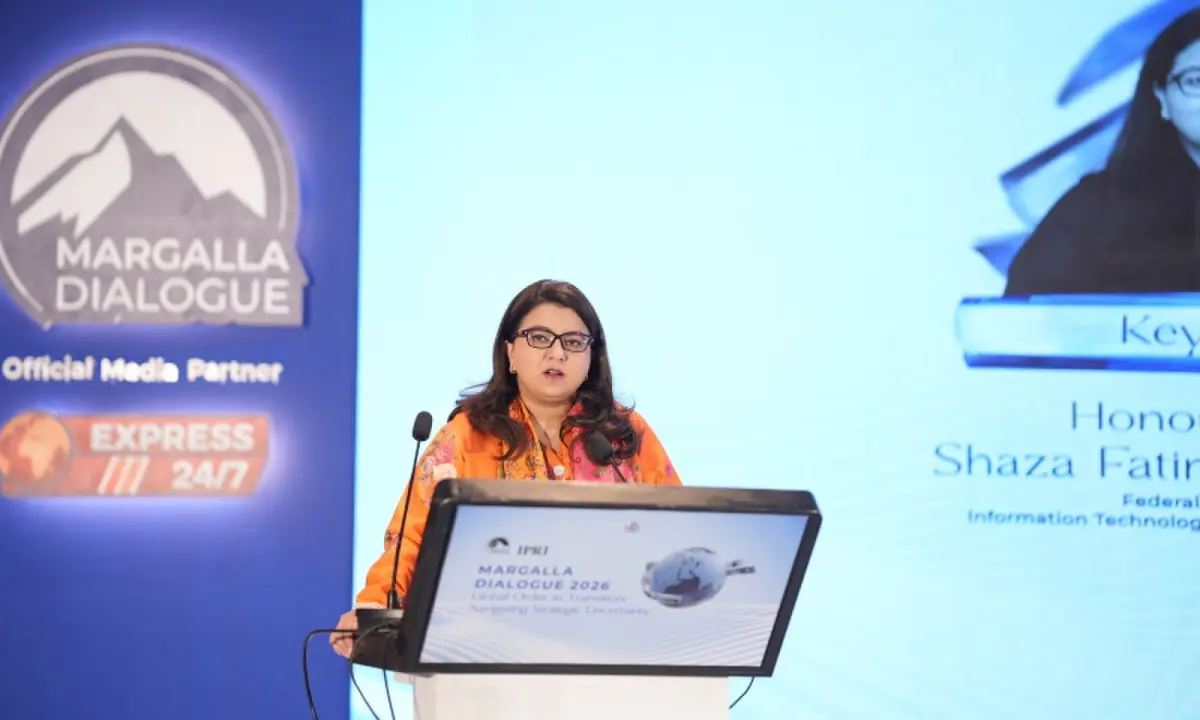
ISLAMABAD: Pakistan is determined to ensure that the global technological transformation, particularly the rapid advancement of artificial intelligence (AI), becomes an opportunity for national development, economic growth and technological sovereignty, IT Minister Shaza Fatima Khawaja said on Wednesday.
She was speaking on the second day of the Margalla Dialogue 2026, during a panel on ‘Technology and Transformation of State and Society’.
Ms Khawaja said technology was fundamentally transforming every aspect of human life — from education, healthcare, finance and social security to national security — while the rapid advancement of AI was further acce-
lerating this global transition and changing the way states, societies and economies functioned.
The key question, she emphasised, was who would steer this transformation and determine the values, identities and realities shaping future societies.
The minister said AI was expected to become a $4.8 trillion economic sector by 2033 and impact approximately 40 per cent of the global employment landscape.
The nature of employment was changing, she added, making future skills and the ability to use AI effectively increasingly important.
Former national security adviser retired Lt Gen Nasser Janjua said the situation had changed and Pakistan was in the eye of the storm due to global power politics.
He stressed that at a time when Pakistan was facing non-traditional security threats, the solutions too had to be unconventional.
Mr Janjua said the presence of the Tehreek-i-Taliban Pakistan (TTP) in the border region between Afghanistan and Pakistan was a serious threat to long-term trade ties from Russia to Pakistan.
“We need to engage Afghanistan as it was in the interest of that country too, while we also have to talk to the leaders of insurgency and separatist movements in Balochistan,” he said, adding: “Conventional way of dealing with insurgents has to change.”
Prof Cheng Xizhong of China’s Charhar Institute lambasted Indian policymakers, calling them adamant and inflexible and saying they were pushing the region into a dangerous zone.
“The Indian efforts to change the demography of Kashmir and with-
drawal from the Indus Waters Treaty can make future conflicts more dangerous,” he said.
Referring to several occasions, he added that while Pakistan had been open to talks, India had always made efforts to complicate negotiations.
Responding to a question on whether China too could stop water flowing into rivers that enter India, Prof Cheng said: “China cannot do that — because we are not narrow minded and water is for all human beings, it should be stored and conserved but not denied.”
Akira Igata of the Economic Security Intelligence Lab at Tokyo University said that as criminals and lawbreakers were actively using advanced technologies and AI, Japan could learn from Pakistan based on its experience in dealing with terrorists.
The international speakers also expressed concern over the management of AI-led services in governance, as there was still a lack of trust among the general public in completely AI-based services, with failures witnessed in many countries.
Pakistan Digital Authority (PDA) Executive Director Dr Rehan Tahir said the key role of the PDA was to develop links and coordination between the databases of the federal and provincial governments.
“Only when the quality data is available — the service quality can improve and processing an authentic data can result in realistic service delivery needs,” he added.
Retired Brig Dr Rashid Wali Janjua, who holds a PhD in peace and conflict studies, said the new security threats would come from AI and the changing face of war in the current age.
He said warfare was becoming lethal, customised and precise with the help of AI, which had made it very fast.
He also referred to Pakistan’s success against a much larger enemy, India, during Operation Sindoor by employing an ‘internet-centric kill chain’, whereas India focused on its traditional mode of superior air power.
Published in Dawn, November 12th, 2026